Reading the Play: When Captains Abandon Ship
Posted: July 26, 2012 Filed under: Reading the Play (Commentary) Comments Off on Reading the Play: When Captains Abandon ShipJuly 26, 2012
Some major names made headlines in the NHL this week. The big news out of Columbus on Monday?

Blue Jackets pull off a blockbuster
Blue Jackets GM Scott Howson bubbled over with enthusiasm as he announced the deal: “We are excited to complete this trade today as we believe the acquisitions … have advanced the club and put us in a stronger position to achieve our goal of winning the Stanley Cup.”
To help introduce Columbus fans to the new players who will be leading the charge for the Cup, the Blue Jackets summarized their career highlights to date:
- Two seasons ago Brandon Dubinsky “set career highs” in goals, assists, and points. (This past season, according to official NHL statistics, his scoring fell by 20 points, almost a 40% drop in production.)
- Four years ago Artem Anisimov ranked fifth in scoring in the American Hockey League. Also, his name is “pronounced a-NEE-see-mawv.”
- Last year Tim Erixon ranked second in points among defensemen on the AHL’s Connecticut Whale. No pronunciation guide was provided for his name.
Talent of that caliber doesn’t come for free, of course, so in exchange the Blue Jackets sent Steven Delisle, a conditional third-round pick, and their captain Rick Nash to New York. The considerate Blue Jackets helpfully summarized the career highlights of Nash as well. He “is the Blue Jackets’ all-time leader in”:
- games played (674)
- goals (289)
- assists (258)
- points (547)
- power play goals (83)
- power play points (182)
- game-winning goals (44)
- shorthanded goals (14)
- hat tricks (5)
- shots on goal (2,278)
- multi-goal games (45) and
- multi-point games (136)
Also, this past season “he led the club … in goals (30) for the eighth straight season and points (59) for the fifth straight season … , while setting a career high in games played (82).”
Anyone can see why Howson was so excited to complete this trade. The Columbus coup, however, was upstaged the next day by the second major news story of the week. The big headline was featured prominently on the Philadelphia Flyers’ website Tuesday:

News for the nearsighted
Here’s a closer look:

A Weber is worth 63 words
Philadelphia’s four-sentence story was dwarfed by coverage around the rest of the league. Flyers GM Paul Holmgren’s terse statement contrasted with the Predators’ press release announcing “the most important hockey transaction in franchise history.”
Nashville, a feisty team on the ice, showed some spirit from the front office, defiantly proclaiming that the Predators won’t “be pushed around by teams with ‘deep pockets.'” Hear that, Minnesota?
Despite Nashville’s well deserved pride in their triumph over the would-be poachers from Pennsylvania, troubling questions remain about the loyalty and commitment of their captain after his dalliance with another team. On Tuesday The Tennessean quoted Weber’s agent, Jarrett Bousquet, saying, “He’s glad to be back…. He’s really happy that ownership made the commitment to him.”
Five days earlier, Bousquet had told TSN Radio 1050 Toronto that Weber would “like to play with the Philadelphia Flyers. He doesn’t want to go through a rebuilding process again.”
Weber himself, slinking back into town with his Predator tail between his legs, disavowed Bousquet’s claims that he wanted to leave Nashville. According to The Tennessean, Weber said in a teleconference yesterday, “I was never a part of any of that. I didn’t make any statements publicly.”
Like a straying husband trying to win back a betrayed wife, Weber professed deep feelings for the city of Nashville, the people of Nashville, and the on-ice employees of Nashville: “I love the city of Nashville. I love the fans and my teammates.” He even expressed great affection for the Predators’ facility, saying “everyone that has played [in Nashville] knows how great the city is and … they love the atmosphere at the rink.”
But surely fans and teammates anxious for reassurance can’t help but notice that Weber failed to mention the franchise and team itself and said nothing about how great it is to play for Nashville. No doubt Nashville boasts better barbecue and warmer weather than Philly, but does Weber really want to play there?
The Predators may put on a good face, but they must confront the strong likelihood that their longtime captain and franchise player would rather not be with them. General manager David Poile, quoted on the league website, likened the 14-year contract to “a marriage”; given that Weber was dragged to the altar after attempting to elope with the Flyers, some marital counseling may be in order.

An awkward family reunion
History does offer hope for reconciliation between Weber and the Predators. Avalanche captain Joe Sakic had a well publicized fling with the Rangers in 1997, signing a front-loaded $21 million offer sheet designed to break the bank for a financially struggling Colorado franchise, but the flirtation was never consummated and, over time, Avs fans renewed their love affair with Sakic. Unlike Weber, though, Sakic made sure his affection for Denver was never in doubt, reported in the (New York) Daily News as saying, “Everyone knows how much I like it here.”
Nashville is not alone in experiencing a captain’s betrayal. The Predators at least have a chance to mend their relationship with their captain; two other teams this summer have lost their star captains entirely. Zach Parise, fresh off a Stanley Cup Finals appearance, fled New Jersey for his home-state team and $98 million. And Nash, who requested a trade away from the Blue Jackets months ago during the season, was clearly thrilled to escape Columbus. The giddy Rangers said on their website that joining New York was a dream come true for Nash and offered a “Rick Nash Quote Book” featuring such memorable lines as: “I wanted to play somewhere that I wanted to be and my number one priority was to be here, and I’m just happy it worked out. This is a world class team, and I’m excited to be here.”

Someone pinch Rick Nash
Every NHL locker room has a revolving door; players constantly come and go. But losing a captain is more than an ordinary roster change and is particularly disheartening when the captain runs for the exit. One other team lost its captain this summer to retirement, but the end of Nick Lidstrom’s tenure is also an occasion to celebrate his long, productive, and exclusive relationship with the Red Wings. The departures of Parise and Nash and the near loss of Weber were rejections of their respective teams, and for New Jersey and Columbus, outright abandonment.
A captain isn’t supposed to abandon ship — even when it’s sinking and certainly not when it just sailed to the Cup Finals. Didn’t Rick Nash or Zach Parise ever watch Star Trek? Captain Picard, the epitome of leadership on the final frontier, always resorted to self-destructing the ship before he’d surrender the Enterprise.

Who best to steer the ship?
In space, at sea, or on the ice, being abandoned by a captain is tough to take. The crew members left behind can’t waste time trying to make sense of their leader’s desertion; they’ve got to scramble for the life boats or try to swim to shore. Even if they make it, they’ll probably spend some time feeling marooned.
Reading the Play: Will Weber “Play On” in Music City?
Posted: July 20, 2012 Filed under: Reading the Play (Commentary) Comments Off on Reading the Play: Will Weber “Play On” in Music City?July 20, 2012
TSN reported yesterday that Shea Weber has signed a 14-year, $110 million offer sheet from the Philadelphia Flyers. The Nashville Predators, already jilted by Weber’s former defensive partner and newly minted Minnesota Wild Ryan Suter, have seven days to match the offer or accept draft picks in compensation for losing their captain.
Weber, who annually plays a forgotten Alydar to Zdeno Chara’s Affirmed in the NHL SuperSkills hardest shot competition, now gets his moment in the limelight: the contract vaults him to the top of the league’s best paid defensemen. According to CapGeek, Weber’s annual cap hit with this offer sheet places him above elite defenders Suter, Brian Campbell, Drew Doughty, and his hardest-shot nemesis Chara.
For the Predators, Suter’s signing with the Wild has triggered a nightmarish domino effect that could cost them their top defensive pair and biggest stars. Suter’s 13-year, $98 million contract with Minnesota not only “reset the market,” in the words of Weber’s agent, Jarrett Bousquet; it also reset the fate of Nashville’s roster. In an interview with TSN Radio 1050 Toronto, Bousquet alluded to Suter’s departure as a key factor in Weber’s desire to leave: “When things changed in Nashville, we felt that everything was set back a year or two and it looked to be more of a rebuilding situation.”
Asked whether Weber hopes the Predators decline to match the offer, Bousquet hesitated only briefly before stating plainly: “To answer your question, … he’d like to play with the Philadelphia Flyers. He doesn’t want to go through a rebuilding process again.”
If Bousquet is correct and the Predators captain wants to play elsewhere, signing a multiyear offer sheet is a risky move; if the Predators choose to match the offer, Weber would be effectively locked into the “rebuilding situation” in Nashville for the remainder of his career. Pressed about the potential for “hard feelings” if Nashville were to retain Weber’s services, Bousquet expressed little enthusiasm for the prospect but downplayed the possibility of lingering conflict: “I don’t foresee there being a problem in that regard.”
Predators president and general manager David Poile — who earlier in the month lamented, “We did not get a chance to make a counter-offer or anything like that” with Suter — reiterated his intention to “match and retain Shea” but noted it would take time to evaluate “the complexity of the offer sheet” — an implied reference to the front-loaded structure of the contract, which according to USA Today pays $28 million in the first 11 months.
Bousquet’s comments suggest Weber, if he does want to play in Philadelphia, is betting the Predators won’t be able or willing to come up with the money. While praising the team as “a great organization,” Bousquet added, “They’re under different constraints than other organizations are.”
Should the Predators fail to retain Weber only weeks after losing Suter to unrestricted free agency, the loss would usher in dark times for a franchise that has achieved consistent success despite playing in a small expansion market where hockey is overshadowed by country music. The Nashville Predators — according to the Nashville Predators — have earned a “reputation as one of the most stable, well-built teams in the NHL.” Sporting News concurs, saying the team is
an organization that has been a hallmark of small-market stability, with only one general manager and one head coach — Barry Trotz — since its inception in 1998. The Predators have been to the playoffs seven of the last eight seasons, advancing to the Western Conference semifinals each of the past two years.
While Poile in the front office has steered the franchise on a steady course, Trotz has managed the bench with the shrewdness of the James Bond villain he resembles.
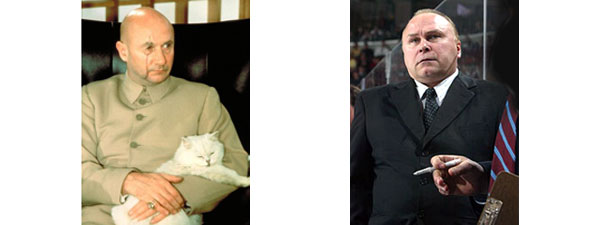
Two masterminds, with and without a cat
Defying expectations for a roster that boasts few marquee names with a payroll currently “more than $13 million below the salary floor,” the Predators have proven themselves a likable, feisty team succeeding not with flashy talent but through character and work. This postseason they eliminated perennial powerhouse Detroit, avenging two previous playoff series losses to the Red Wings.
But for a team that has always been short on elite talent, sustaining success will be a challenge without the two stars that have headlined their blue line. Aside from Weber, Suter, and the towering (6’5″), top-tier (league-leading 43 wins), underrated goalie Pekka Rinne, the most high-profile Predator is Mike Fisher, probably better known in Music City as country singer Carrie Underwood’s husband. Fisher, a forward, tallied only two more points (51) than defenseman Weber (49) during the 2011-2012 regular season; Suter contributed another 46 points. Weber led the team in plus-minus at +21; Suter was next at +15. No wonder Sporting News predicted that “[i]f Nashville lets Weber go after losing Suter, it will take years to recover.”
Now that Suter’s gone and captain Weber has one skate out the door, the future of the Nashville Predators rests solely on the thin shoulders of Pekka Rinne. His net could feel very lonely next season.
For Rinne, here are a few words of encouragement from Predators wife Underwood, taken from the title song of her third album:
Don’t you ever give up the fight
Even when you feel you’re all alonePlay on, play on
Reading the Play: Cracking the Ice Ceiling
Posted: July 14, 2012 Filed under: Reading the Play (Commentary) Comments Off on Reading the Play: Cracking the Ice CeilingJuly 14, 2012
The Chilliwack Progress reported yesterday on a “headache” facing the Chilliwack Minor Hockey Association (CMHA).
The Progress, of course, is Chilliwack’s 120-year-old “newspaper of record,” and Chilliwack, for the uninitiated, is a city of 80,000 located east of Vancouver which prominently features a large ear of corn on its official website.
Two parents whose children play in the CMHA have filed a formal complaint against the association with the B.C. Human Rights Tribunal, alleging gender discrimination. At issue is the CMHA’s recently instituted policy of levying a surcharge against players on girls’ teams. Members of boys’ or coed teams are not charged the extra fee.
The CMHA — whose league fees are structured on a per-player, not per-team, basis — has presented the policy as a simple business decision, citing the smaller rosters on girls’ teams which bring in less revenue per team. Its response to the lower rates of participation by girls is to increase the cost of participating.
The legal complaint will be decided via mediation or a hearing; resulting orders are enforceable in the B.C. Supreme Court. Whatever the outcome, the case has drawn attention to the place of women in hockey.
The state of women’s hockey last made news in 2010 when IOC president Jacques Rogge threatened to cut the sport from the Winter Olympics, setting a festive tone just hours before the gold medal game. Underdeveloped programs in every country except Canada and the U.S. result in lopsided games and a two-horse race in every international tournament.
Even within the two nations that dominate women’s hockey, participation by female players lags far behind their male counterparts. Despite what Hockey Canada describes as “exponential growth” in women’s hockey since the first World Women’s Championship in 1990, male players registered with the organization outnumbered females almost 6 to 1 in 2008-2009, the most recent year for which statistics are available. In the nation’s capital, male registration in the Ottawa District Hockey Association outnumbered female registration nearly 24 to 1.
With 2012 marking the 40th anniversary of Title IX, the landmark and controversial U.S. federal law best known for mandating gender equality in college sports participation, celebration of progress achieved must be tempered with awareness of work yet to be done.
This March The Gazette, native to hockey hotbed Montreal, examined the hockey lives of the Clarkson Cup-winning Montreal Stars, this year’s champions of the five-year-old, five-team Canadian Women’s Hockey League. The NHL recently raised its salary cap to $70.2 million for the upcoming season; meanwhile, players’ salaries in the CWHL jumped from negative $1000 to $0 minus the cost of food and sticks:
If you ask an NHL player about his love for the game, he might tell you that he loves it so much he would play for free.
The women love it so much they pay for the right to play.
“Things are getting better,” said Lisa-Marie Breton-Lebreux, the Stars’ captain and a driving force behind the creation of the league in 2007. “Last year, everyone on the team had to pay $1,000 to play. We have some sponsors and the crowds are a little better, so we don’t have to pay this season.”
But it’s still not free. While Bauer has supplied equipment to the players, they still pay for their sticks and they’re on the hook for their meals on the team’s seven road trips.
At least the Stars’ championship season was rewarded with a free meal and a suite at the Bell Centre when they were later honored at a Canadiens home game (though the food probably came at the price of witnessing Scott Gomez’s painfully futile efforts on the ice).
It’s been 20 years since groundbreaking goalie Manon Rheaume, the Geraldine Ferraro of hockey, signed a professional contract with the Tampa Bay Lightning in 1992.
Hockey’s Hillary Rodham Clinton has yet to emerge: no woman has repeated Rheaume’s feat. But the next one may be lacing up her skates at a rink near you.
Reading the Play: Engineering A Better Goalie
Posted: July 11, 2012 Filed under: Reading the Play (Commentary) Comments Off on Reading the Play: Engineering A Better GoalieJuly 11, 2012
As NHL fans and GMs wait for Shane Doan and Shane Doan waits for Coyotes ownership, Phoenix is receiving attention for signing a member of its off-ice team — goalie coach Sean Burke — to a contract extension yesterday.
The Coyotes promoted Burke, who had served three seasons as Goaltending Coach/Director of Prospect Development, to the new title of Director of Player Development/Goaltending Coach. Burke’s coaching resume features impressive results from his students in the Phoenix net: Mike Smith, Ilya Bryzgalov, and Jason LaBarbera all achieved career years during Burke’s tenure as goalie coach. He has been called a “mastermind,” a “goalie guru,” and, by Smith himself, “the best guy in the league at what he does.”
In Toronto, another Burke — Leafs GM Brian — has been fending off criticism of his own goalie coach, Francois Allaire — the original goalie guru. Allaire built his reputation by building the careers of goaltending luminaries including Patrick Roy and Jean-Sebastien Giguere. But recent critics accuse him of being “too dogmatic” and imposing a “rigid and outdated” style of goaltending that’s “more about solely playing the percentages and being hit, as opposed to making athletic saves.”
The playing-the-percentages approach to goaltending seems to have fallen out of favor lately. Critics argue that an overemphasis on technique and positional blocking produces goalies with subpar reflexes and athleticism. The Leafs GM tacitly conceded the point, noting, “We’ve encouraged Allaire to be open to more acrobatic styles.”
But not so long ago goalies were taking criticism for relying on acrobatics at the expense of sound technical play. During the 2009 Stanley Cup Finals, the second consecutive Finals showdown between Chris Osgood and Marc-Andre Fleury, The Globe & Mail said of Fleury, “[H]e relies on his athleticism a little too much to get out of jams.” Retired NHL goalie Phil Myre, in a 2010 post on his website laying out “5 Commandments of Goaltending,” warned aspiring netminders, “Overactive goalies often get out of position and have to rely on reflexes too much.”
Joining the debate yesterday was an unusual source of goaltending wisdom: EA Sports, maker of the NHL 13 video game and its predecessors. On the NHL 13 website and in a newly published promotional video, EA Sports touts the upgraded goaltending in this year’s edition of the game. What do hockey fans want from their goaltenders? If the marketing department at EA Sports is right, most fans want goaltenders who shun technique for “the drama of the desperation save.” For these fans, “NHL®13 now features the most athletic goalies ever seen in a video game. In the first period or with the game on the line, your favorite netminders scramble with more versatility and anticipate like never before.”
So what is the best formula for better goaltending?
The experts at Hockey Canada, the organization charged with developing amateur hockey in the game’s native land, think they’ve perfected it. Here is Hockey Canada’s official formula for the ideal beginner goalie:
• 75% movement and positional skills
• 20% save movement
• 5% tactics
For advanced goalies, the formula becomes more complex:
• 35% movement and positional skills
• 10% post-save consequences
• 40% tactics and transition
• 15% advanced positioning
Not satisfied with a simple percentage breakdown, Hockey Canada thoughtfully provides coaches with a downloadable spreadsheet for conducting “Goaltender Evaluations.” The 65-point checklist measures goalies’ strength on criteria as basic as “Skating ability” and as offbeat as “Size of heart,” “Controls temper,” and (naturally) “Coachability.”
But for all the competing and complicated attempts to define the ideal goaltender — whether by programming video game algorithms or charting percentages on a spreadsheet — the true measure of a goalie comes down to two simple questions, which happen to be the final items on Hockey Canada’s list:
“Can this player play? Would you want this player on your team?”

 Covering the Puck
Reading the Play: Who Owns Hockey?
Posted: January 25, 2013 | Author: Covering the Puck | Filed under: Reading the Play (Commentary) | Comments Off on Reading the Play: Who Owns Hockey?January 25, 2013
For the NHL, this is a watershed moment: “The National Hockey League’s Board of Governors today ratified the terms of the Collective Bargaining Agreement negotiated with the NHL Players’ Association, … signaling a new era of cooperation and partnership.” After the ordeal of a rancorous labor dispute and lengthy lockout, the league is to embark on a new age of peace and prosperity.
But it’s July 22, 2005, when the NHL proclaims a new dawn, and the “new era” will not last. Seven years later, the league again locked out the players and commenced another rancorous labor dispute.
Like the fabled Aztec empire, the golden age of the National Hockey League was glorious but short-lived … although it did not end with the execution of its leader. Before its demise, the league’s new era flourished, achieving extravagant riches — more than $3 billion a year in revenue — and rapid growth — a 51% increase in franchise value.
What went wrong?
Somehow, the historic “cooperation and partnership” established between the league owners and the players in 2005 dissolved into accusations and acrimony. Who was at fault?
The dispute between league ownership and players is often dismissed as a battle of “the rich” (players) “versus the richer” (owners). The combatants are exceptionally wealthy, the fight over division of dollars is petty, and the whole mess boils down to greed.
But the relevant distinction between owners and players is not net worth; it is the position each occupies in the business of hockey. The conflict between ownership and players is better understood as employer versus employee; capital versus labor. The NHL is no different from Walmart in its agenda to minimize employee compensation and rights while exploiting employees’ talent and sweat for its own profit.
In many ways, as usual, capital has the upper hand in this fight. But the unique economics of professional sports changes the dynamics of this particular labor dispute. Ownership must confront the fundamental truth that owners are easily replaceable — with several aspiring owners waiting in the wings — but the players are not.
Predictably, NHL ownership does its best to deny this reality and portray the players as overpaid and selfish. But the common characterization of major-league professional athletes as “greedy” and “spoiled,” aided by the general public’s resentment of their large salaries, conflicts with the economic facts of the industry.
To begin with, player salaries are substantially smaller than commonly assumed. While the highest-paid superstars make headlines with their contracts, most players make far less. The number typically quoted as the average player salary in the NHL is the mean salary, $2.4 million in 2011-2012. But this figure is inflated by outliers at the top: the four players, out of about 700 players across the league, who earned $10 million or more.
A better measure of the typical player’s situation is the median salary, the midpoint between highest and lowest, which is only $1.5 million1. The mode, the salary earned by the largest group of players, is even lower: under a million at $900,0002.
One year earlier, in the 2010-2011 season, NHL executives whose salaries were reported by the league were paid an average (mean) salary of $2.2 million. The median executive salary that year was $1.5 million. (The sample was too small to have a useful mode.)
Although the two data sets are not quite comparable — the figures for player salaries are more recent and therefore inflated — they are sufficient to illustrate the relative scale of pay in the NHL.
NHL executives make the same amount of money, on average, as the players whose salaries the league insists on cutting. Commissioner Gary Bettman was paid $7.98 million; he received a larger salary in 2011 than 98% of the players did in 2012.
Of course, while NHL player salaries are nearly identical to NHL executive salaries, they are undeniably far larger than average in the economy as a whole. However, players’ unusually large salaries are consistent with the unusually large amount of revenue generated by their labor.
Major league sports is a huge business that produces billions of dollars of revenue annually from the work of a small labor force. Averaged across the four major sports leagues in North America and based on figures reported by the Chicago Tribune in November 2012, the business of professional sports generates $5.9 billion a year in revenue for each league while employing 866 players3. That’s an average of $6.8 million in revenue per player.
In comparison, the average S&P 500 company last year earned $420,000 in revenue per employee.
High player salaries are fully consistent with the revenue they produce; in this case, compensation correlates with productivity. The value of a commodity should also correlate with its scarcity — and a hockey player who makes it to the NHL is a precious rarity.
How scarce is NHL-caliber ability?
In 2012 the International Ice Hockey Federation (IIHF) reported over 1.6 million registered hockey players across its 72 member federations worldwide. Nineteen of these member nations had a player in the NHL last season. Limiting the field to males registered in these 19 countries leaves a total of 1.36 million hockey players who might dream of playing for the Stanley Cup. The 690 players who made it to an NHL team represent 0.05% of this talent pool.
What about the value of an NHL franchise owner?
Ownership of a professional sports franchise requires one qualification: the ability to make money or the good fortune to inherit or marry into it. NHL owners are perfectly qualified for this position — they’ve been exceptionally successful in making piles and piles of money. Among the 30 franchises, 10 NHL owners have managed to accumulate $1 billion or more in net worth, all of them from the U.S. or Canada. They comprise 2.2% of the pool of 450 billionaires in these countries.
A billionaire is 44 times more likely to buy an NHL franchise than a male hockey player is to make an NHL team. Put another way, an NHL-caliber player is 44 times more scarce than an NHL-owning billionaire — and scarcity, if any Econ 101 textbook can be trusted, drives economic value.
As employees, NHL players are compensated not only for high productivity and a rare skill set. Their occupation requires personal sacrifices: they give up time with their families, the stability of living in the same city from one year to the next, and most of all, their own health. Players risk serious injury every time they step on the ice. Injury can entail major surgery, painful rehab, and sometimes long-term physical, psychological, and cognitive damage. Cumulative or acute injuries that shorten or end careers can also cost millions in lost income.
The NHL obscures public information about injuries, but data tracked down and compiled by The Globe and Mail reports a total of 6,751 man-games lost to injury near the end of the 2010-2011 season, with an average of nine games still remaining for each team. On average, at every NHL game, three players on each team are unable to play due to injury.
Information on the number of sick days taken by Gary Bettman and other league executives and owners that year does not appear to be readily available. The number of work-related surgeries, lost teeth, and stitches among all NHL owners and executives is estimated to be zero.
Anyone with a fat bank account can buy a hockey team, but only a special few can play for it. How much do owners contribute to producing the $3 billion in annual league revenue? How much is due solely to the talent and sacrifice of the players?
But the NHL’s repeated labor disputes are not only about economics. At a deeper level, this conflict is about the meaning and ownership of hockey.
To NHL franchises, hockey is a commodity sold for profit. The league stages games to sell tickets — the single biggest source of revenue, comprising fully half of league income — and to drive demand for ancillary products such as broadcast rights, licensed merchandise, and concessions. For NHL owners, selling the game of hockey is like making widgets.
To players, hockey is a livelihood, a trade, but also a calling. They may be human widgets in the eyes of ownership, but professional hockey players are more akin to virtuoso artists. They practice an esoteric craft at the highest level, and by performing it for the pleasure of others are able to earn a living. Most hockey players, like most painters, musicians, and writers, can pursue their art only as a hobby. Most pay for the privilege. Only the rarest practitioners succeed in turning a passion into a career.
The league owns the franchises, but it does not own the game and it does not own the players.
To the owners, their employers, the players owe only the fulfillment of their contract obligations. Loftier contributions such as loyalty, respect, or even giving a damn about their work are purely optional; ownership and management don’t always grant these courtesies to players and they are not entitled to receive them. Players care because they owe it to themselves and they owe it to the magnificent game they are privileged to play.
Hockey belongs to its players. Not the owners who sign NHL paychecks, not the rinks that rent ice time, not even the fans who buy tickets. The players alone bring the game to life. From peewee to the pros, from the shaky adult beginner to the aspiring Olympian, every hockey player understands — and lives — the spirit of the game in a way no franchise owner, business executive, or league commissioner ever can.
Hockey lovers who return to the NHL after each corrosive labor dispute are drawn by the joy of witnessing the game performed at its highest level. The players are both the creators of this product and its sole owners — and no lockout or CBA can change that.
1 Calculations based on figures from the USA Today NHL salary database.
2 Calculations based on figures from the USA Today NHL salary database.
3 Based on number of teams multiplied by roster size: NFL, NBA, MLB, NHL.