Loose Pucks: Curse of the Blue Shirts
Posted: January 29, 2013 Filed under: Loose Pucks (Miscellaneous) Comments Off on Loose Pucks: Curse of the Blue ShirtsJanuary 29, 2013
As discussed previously, new Sharks pickup Scott Gomez is attempting to reverse a steep career decline. The former star’s career has plummeted from lofty heights — taking home the Calder Trophy as rookie of the year and winning two Stanley Cups with the Devils — to stunning lows — a humiliating contract buyout in Montreal and a spot on the fourth line in San Jose.
Gomez suffered a sharp decline in production after his first year in Montreal. In 2009-2010, after the Canadiens acquired Gomez and the rest of his $51.5 million seven-year contract from the Rangers, he scored 59 points in 78 games, or 0.756 points per game. In the following two seasons, he produced only three more points while playing 40 more games, for a point-per-game average of 0.525. That’s more than a 30% drop in scoring.
No one seems able to explain the sudden and drastic loss of scoring ability, least of all Gomez himself. During the dark days of his more than year-long stretch without scoring a goal, The (Montreal) Gazette could only ask plaintively, “Will Scott Gomez ever score again?” Gomez simply expressed disbelief: “This whole thing is surreal to me now. I can’t help but think: ‘Are you kidding me?'”
But Gomez may not be directly responsible for the spectacular collapse of his hockey career. Perhaps he simply succumbed to the malady that has claimed many stronger victims before him: the Rangers curse.
It was the New York Rangers who originally signed Gomez to the bloated contract that Montreal just unloaded. Before the Rangers came calling, Gomez was doing just fine in New Jersey. Then the spendthrift Rangers snapped up their Tristate neighbors’ rising star, showered him with cash, and ushered in the inevitable demise of his hockey career.
The Rangers have a history of spending freely (and conspicuously) to buy other teams’ talent. Why nurture home-grown talent when you can just buy players someone else nurtured for you? Like any rich New Yorker, the Rangers aren’t about to take the subway to success when they have plenty of cash to pay for a cab.
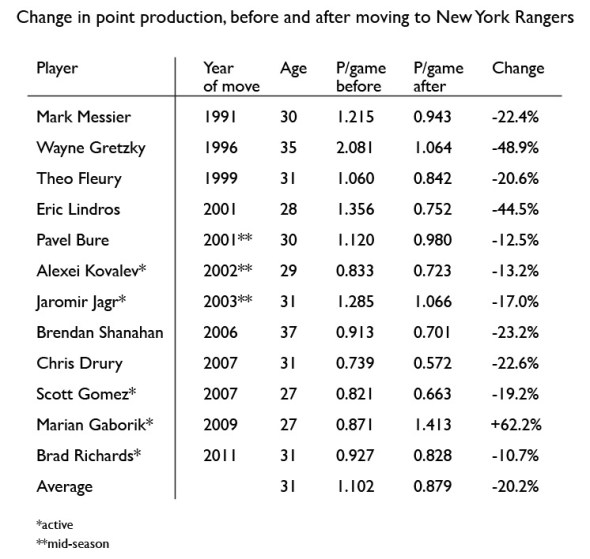
The trouble is, most of their blockbuster acquisitions broke down after a few miles. Moving to Manhattan, for NHL players, can spell doom for even the most promising career. Consider these statistics for the following 12 high-profile Ranger acquisitions during the 1990s and 2000s:
The wrong move
Mark Messier led the Rangers to a Stanley Cup, and he still couldn’t escape the Rangers curse; his scoring dropped 22%. Wayne Gretzky is Wayne Gretzky, and he couldn’t escape it either: his points per game decreased almost by half.
Even Alexei Kovalev couldn’t escape the Rangers curse, and he started with the Rangers. But then he went to Pittsburgh for five seasons, where he recorded a career-high 95 points in 2000-2001. After enjoying success outside New York City, Kovalev was just asking for trouble when he moved back to the Rangers during the 2002-2003 season. His point production dropped by 13% from his previous average (including his original stint with the Rangers). Leaving another NHL team and moving to Madison Square Garden is how players catch the Rangers curse, and previous exposure does not provide immunity.
One player does seem to have overcome the odds and beaten the curse: Marian Gaborik has so far achieved an increase in points per game since coming to the Rangers, though he will still need to monitor the remaining years of his career for symptoms. Maybe he has a genetic anomaly that reduces his susceptibility. Even the Black Death spared a lucky few.
Overall, however, the data clearly establishes substantial loss in scoring following a move to the Rangers. Of course, other factors could contribute to the post-Rangers decline in scoring — lack of chemistry with new teammates, perhaps; difficulty coping with the pressure of a gaudy contract and heavy expectations; or simply the passage of time as players enter the later stages of their careers. To determine the true effect of the Rangers curse independent of general adjustments, normal career decline, and other secondary factors, a control group is needed. Fortunately, history provides the perfect case study, the superstar player the Rangers went after but didn’t get: Joe Sakic.
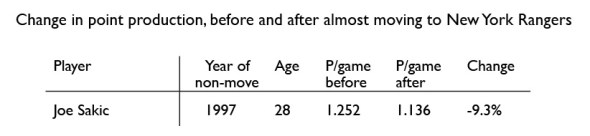
In the summer of 1997 the Rangers signed Sakic, then a Group 2 free agent, to an offer sheet. Had the Avalanche not matched the offer, Sakic would have begun his Rangers career the following season. Here are his numbers:
Dodged a bullet
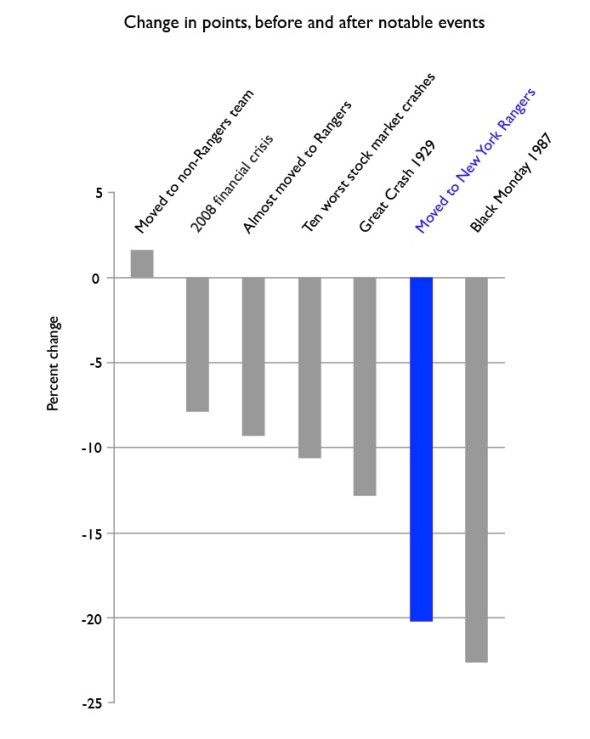
Like the sufferers of the Rangers curse, Sakic produced fewer points in the second segment of his career — that is, during the seasons following his near-move to the Rangers. But Sakic’s scoring decreased by only 9.3%, while scoring by the players who actually did move to the Rangers dropped by 20.2%, more than twice as much. Sakic was younger at the time of his non-move than the Rangers group as a whole when they did move, but Eric Lindros is the only Ranger of comparable age whose career, like Sakic’s, has already ended — and Lindros suffered a particularly severe case of the curse with an appalling 44.5% drop in scoring.
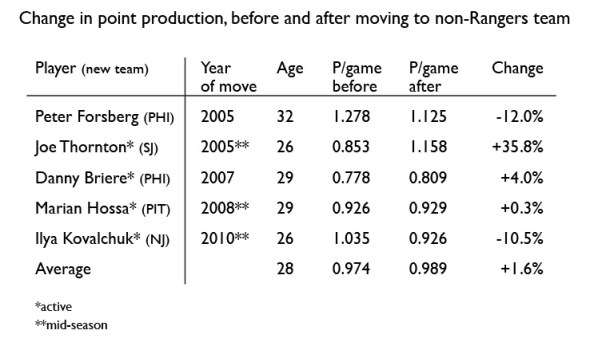
Sakic’s unique status as an almost-Ranger provides a helpful comparison, but he’s still only one player — too small a sample size to be convincing alone. For a second control group, consider the following six high-profile acquisitions by teams other than the Rangers:
Good hygiene
On average, prominent players who moved to teams other than the Rangers actually increased their scoring slightly after the move. The difference between the non-Ranger group’s 1.6% increase in scoring and the Ranger group’s 20.2% decrease is almost 22 percentage points.
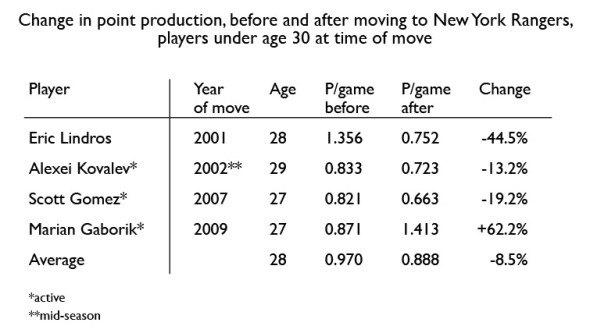
In fairness, these players were three years younger than the Rangers group, as a whole, when they changed teams. (Age at the time of the move is based on opening day of the new season for offseason acquisitions or the date of the trade for mid-season acquisitions.) Just to be sure, look at the Rangers group again, this time limiting it to players under age 30 when they moved:
Young and robust … but not immune
These younger players changed teams at the same age as the control group (28 on average), but their scoring still decreased 8.5% compared to the control group’s 1.6% increase — a 10-percentage-point difference. While this particular comparison is useful for addressing the age factor, it’s important to note that most players in this age group — both Rangers and non-Rangers — are still active in the NHL, so their final career trajectories are yet to be determined.
Taken in totality, however, empirical analysis of the available data leads to only one conclusion.
Yes, the Rangers curse is real. But how bad is it really?
To put the numbers in perspective, it’s helpful to see what a small percentage-point difference can mean in terms of real-life changes. Conveniently, the real world offers a useful model in the stock market, which like a hockey player’s scoring is measured in points.
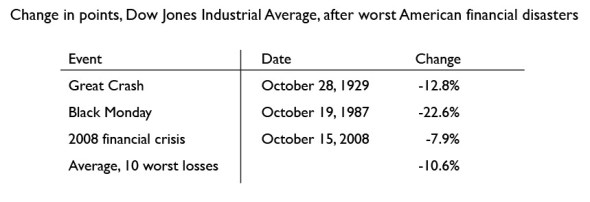
Based on data from The Wall Street Journal, here are three of the worst one-day losses in the Dow Jones Industrial Average, as well as an average of the 10 worst losses all time, in U.S. history:
Free fall
Put it all together and a clear picture emerges, revealing a virulent sickness in the NHL. For the visually oriented, here is the data aggregated in a graph showing the percentage change in points before and after several notable events, including a move to the New York Rangers:
Worst calamities
Distilled into simple terms, the Rangers curse is more destructive than the stock market crash preceding the Great Depression. But the effects of the curse are slightly better than the single worst nosedive in American financial history, Black Monday in 1987. Perhaps new additions to the Rangers can find a measure of comfort in that fact.
Can a cure be found? Funding for research has yet to present itself, despite all of the disease’s victims being celebrities. The prospects for treatment seem dim.
Rick Nash, take your vitamins.
Loose Pucks: The Great Gomez
Posted: January 27, 2013 Filed under: Loose Pucks (Miscellaneous) Comments Off on Loose Pucks: The Great GomezJanuary 27, 2013
Every NHL team begins the regular season in pursuit of the same elusive (and for some, highly improbable) goal: winning the Stanley Cup. This season, the always ambitious San Jose Sharks have undertaken what may be an even more daunting challenge: resuscitating the career of Scott Gomez.
Gomez’s last two seasons as a Montreal Canadien were, as the Anchorage Daily News diplomatically puts it, “unproductive”: 9 goals in 118 games, including an infamous 368-day drought1 between goals. Despite general manager Marc Bergevin’s previous statement to the contrary — “I’m not buying him out,” Bergevin told LNH.com last July — Montreal placed Gomez on waivers and bought out his contract on January 17. How much is it worth to Montreal to be rid of Scott Gomez? The Canadiens will pay $9.2 million to Gomez over the next three years to not have his services.
Gomez’s career hit its lowest point (he hopes) on November 7, 2012, during the NHL lockout, when he signed a contract with the Alaska Aces of the ECHL. The ECHL is a “developmental league for the American Hockey and the National Hockey League” — in other words, two tiers below the NHL, sort of like Double-A baseball. Double-A is where Michael Jordan played baseball, and he was coming from a sport where the ball is a totally different size and color. Scott Gomez went to the second-tier minors in his own sport, where pucks come in only one size and color.
Here are some of the most frequently asked questions on the ECHL website:
- What do the letters ECHL stand for? (Answer: East Coast Hockey League.)
- What is the minimum salary for an ECHL player? (Answer: $425 per week.)
- How can I try out for an ECHL team? (Answer: After “selecting a team logo on the top of the site,” simply “contact the general manager or coach.”)
The Alaska Aces commended Gomez as “the most decorated hockey player from Alaska”; the Anchorage Daily News echoes that he’s “the most accomplished hockey player from Alaska.” He may even be able to see the KHL from his parents’ house in Anchorage. In happier times, Gomez brought the Stanley Cup to his hometown of Anchorage and went to Hollywood for a cameo role in the daytime soap opera One Life to Live.
But by now, like the down-on-his-luck Gonzo the Great in Disney’s 2011 movie The Muppets, Gomez must know that his “career is down the drain.”
Perhaps he can find inspiration in Gonzo, who after a stint in the plumbing business managed to revive his trademark “stage act, which includes shooting himself from a cannon, balancing a piano on his nose, or eating radial tires to classical music.” Compared to those tricks, putting a puck in a net should be easy.

Alaska’s best and the Muppets’ … whatever
Scott Gomez hopes so. Now that the Sharks have taken him on, he’s eager to prove himself. “It just feels like ages since I’ve played in an NHL game,” he told the Daily News, adding helpfully, “I know I can play.”
Gomez isn’t satisfied merely to play again in the NHL, though; he wants to go all the way. “I’m addicted to winning,” he told The (Montreal) Gazette on the day he signed with the Sharks. (One can only wonder how he’s survived the withdrawal.) “You play to have a shot at a Stanley Cup, especially if you’ve won one. I’m not ready to give that up.”
The revitalized Gomez apparently believes his new team can help him get his Stanley Cup fix. Others agree that the new contract amounts to a rescue. Perhaps inspired by San Jose’s marine mascot, several observers have employed a nautical metaphor to describe the Gomez signing. From The Vancouver Sun: “the Sharks have thrown him a lifeline.” From CBC Sports: “Scott Gomez resurfaces with Sharks.” And the headline in The Gazette: “Gomez grasping at Sharks lifeline.”
But are the Sharks really the right team to rescue Scott Gomez from drowning in hockey ineptitude? The Sharks themselves have been lost at sea for years, and every time they saw land on the horizon it turned out to be a mirage: regular-season wins masquerading as signs of imminent playoff success. San Jose has earned a top-four seed in the playoffs every year since the 2006-2007 season, with a combined 295-141-56 regular-season record and a 0.600 winning percentage. According to the analysts at NHL.com, “It’s not often a conversation about the top teams in the Western Conference each season doesn’t include the San Jose Sharks,” and they have been “a serious Stanley Cup contender” ever since acquiring Joe Thornton in 2005.
Yet year after year the Sharks have failed to contend for the Cup in the Finals. Twice they reached the conference finals, but they won only one game in the two series combined; in 2010 they were swept by the eventual Stanley Cup champions, the Blackhawks, and in 2011 they managed only one win against their fellow Western Conference chokers, Roberto Luongo’s Canucks. In three of the remaining four seasons in which the Sharks entered the playoffs as a top seed, they exited in first-round defeats to their lower-seeded opponents. Since 2007, the Sharks have lost 34 of 61 postseason games for a 0.443 win percentage.
This is the team you want towing you to shore?
For Scott Gomez, it is. He made his Shark Tank debut yesterday in a shutout victory over the Colorado Avalanche. In case you’re wondering, no, he did not score a goal.
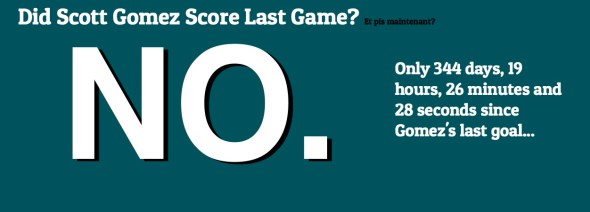
Speaks for itself: from the wonderful folks at DidGomezScore.com
Gomez replaced fellow center James Sheppard on the fourth line — small skates to fill for a former top-six forward and two-time All-Star. Sheppard, drafted 9th overall by Minnesota in 2006, totaled 53 points in his first two seasons with the Wild but scored only 6 points in 64 games in 2009-2010. He spent last season in the AHL; in his two games with the Sharks this season, Shepard racked up a total of 14:47 on the ice with 2 shots and 2 minutes in penalties.
Gomez was able to top Sheppard’s numbers with 15:03 of ice time and 3 shots on goal in his first game for San Jose, but he also muffed a golden opportunity to score late in the third period when, as the San Jose Mercury News described it, he got “a look into a wide-open net, only to lose control of the puck.” Maybe the pucks in Double-A are less slippery or not as round.
If Gomez was drowning when San Jose dragged him aboard, the Sharks themselves were treading water at best. Now the player best known for scoring futility and the team best known for playoff disappointment will try to carry each other to the misty, far-off land of champions.
1 Calculation based on goals scored on February 5, 2011, and February 9, 2012, not including the dates each goal was scored.
Loose Pucks: Popcorn, Pretzels, and Pucks
Posted: January 22, 2013 Filed under: Loose Pucks (Miscellaneous) Comments Off on Loose Pucks: Popcorn, Pretzels, and PucksJanuary 22, 2013
With the lockout over and an abbreviated season underway, the NHL has concluded the vexing business of CBA negotiations and briskly moved on to the business of marketing the league.
In its celebratory slogan “Hockey Is Back,” the NHL has adopted the grateful tone of a pet owner whose lost puppy finally showed up on the doorstep after a bewildering absence. Never mind that the NHL owners threw their puppy out in the cold four months ago and locked the door. Fido is home again now and all is forgiven.
The last time owners were reunited with their wayward puppy, they expressed their gratitude with extravagant gestures: miniature Stanley Cup replicas handed out to fans at every home opener and the words “Thank You Fans” painted on the ice in every arena. This time, the owners are more jaded. They’ve been through this routine before.
So the NHL is bypassing any organized league-wide demonstration of appreciation for the fans, instead leaving the task to individual teams who, as the league put it in a lukewarm announcement, are thanking fans for their loyalty “using a variety of methods.”
Some NHL clubs, in keeping with the league’s apathetic response, are marching ahead with business as usual, making only perfunctory mention of the new CBA and redirecting fans’ attention to routine news items such as roster moves, ticket sales, and season previews. Among the teams choosing to move on quickly and forgo conciliatory post-lockout gestures to the fans are the Bruins, Oilers, Devils, Rangers, and Canadiens. Attempts at fan appreciation are noticeably absent from the news headlines on these teams’ websites.
The Rangers focused on bigger news, such as the expansion of the Crown Collection, a Henrik Lundqvist-designed fashion line featuring “a signature fitted jacket, hooded sweatshirt, a new fitted cap style, a knit scarf,” and “select novelty items.” After all, although Lundqvist’s performance on the ice so far is weak — a 4.77 goals-against average and 0.865 save percentage, ranking 34th and 32nd respectively in a league with 30 starting goaltenders — his fashion sense is unbeatable.
Not all NHL teams are taking their fans for granted, however. Some franchises spared no expense in showing goodwill to their fans. Both the Avalanche and Lightning offered fans the chance to buy a hot dog for only one dollar. The Lightning also offered a $2 beer special and hosted “Free Lunch Friday with the Lightning,” serving “hot dogs, Italian sausages, and hamburgers” (vegetarians were out of luck).
The Blues could only swing a buy-one-get-one-free deal for their hot dogs, for which they normally charge $4 each, meaning Blues fans were still paying twice as much as Colorado and Tampa Bay hot dog eaters for their discounted convenience-store fare. The Blues made up for the pricey hot dogs by offering “a FREE 12 oz. Pepsi” (drinkers of Coke, despite being on the winning side of the cola war, were out of luck). And as if hot dogs and soft drinks weren’t enough, lucky Blues fans also received “a coupon good for $10 off a $50 purchase at Famous Footwear.”
The most appreciated fans, though, were those in Pittsburgh and Washington, where fans were treated to a smorgasbord of movie-theater-quality food. The Capitals even added dessert to the menu, providing “[c]omplimentary fountain soda, popcorn, pretzels, hot dogs, nachos and ice cream” at their “special Thank You event” for fans. Penguins fans got no ice cream but were given “a voucher for three free concession items” and could “choose from among hamburgers, hot dogs, chicken sandwiches, nachos, popcorn, pretzels, salads and fountain drinks.”
Although not related to the lockout, the Flyers announced a junk food deal for their fans too. Thanks to “their season-long partnership with Papa John’s,” purveyor of mediocre delivery pizza, fans will receive 50% off their order after any game in which “the Flyers score 3 goals or more and win.” Flyers fans may want to make other dinner plans, however, since Philadelphia is 0-2 with a total of three goals scored so far this season.
With or without pizza and hot dogs, and despite scattered threats of boycotts and other fan retaliation for the lockout, fans are returning to the NHL. The league’s apathetic reception of its fans has been rewarded with sellout crowds and record TV ratings, a fact smugly noted by commissioner Gary Bettman.
For better or worse, the NHL doesn’t need to give its fans cheap food to win back their patronage. A deeper hunger brings them back, one the league can take no credit for: the love of hockey.
Loose Pucks: Breaking Boundaries
Posted: July 13, 2012 Filed under: Loose Pucks (Miscellaneous) Comments Off on Loose Pucks: Breaking BoundariesJuly 13, 2012
NBC Washington yesterday profiled two aspiring NHLers with unconventional national backgrounds who are attending the Capitals’ Prospect Development Camp this week. The longer shot of the two is undrafted free agent Nathan Walker, who hopes to become “the first-ever Australian in the NHL” despite being passed over in the 2012 entry draft last month.
Europeans are well represented in North American pro hockey — 2012 Calder Trophy winner Gabriel Landeskog was the first European-born captain of a Canadian major junior team and newly retired Nicklas Lidstrom became the first European-born captain of a Stanley Cup champion team — but players from other continents remain out in the cold (or in this case, the dry heat). Mites and squirts hitting the ice at Australian hockey rinks — all 20 of them — can look to Walker to blaze the trail.
Not a hockey powerhouse, Australia does have some things in common with the game’s birthplace. No less an authority than the Toronto Star — “Canada’s largest daily newspaper”— declared in a 2010 column that
Australia and Canada have been linked in the world’s minds for a century. Both are geographically sprawling, resource-based, former British colonies that share language, history and guilt-laden problems with their native people and have become two of the richest nations in the world.
Regardless of whether Australia and Canada have ever been uppermost in the world’s minds — separately or together — the Star acknowledges that “the surface similarities mask fundamental differences” — none more fundamental than the state of hockey in each nation. There are six professional hockey leagues playing in Canada (NHL, AHL, ECHL, WHL, OHL, and QMJHL). There are nine teams playing in the “completely amateur” Australian Ice Hockey League, not only the country’s top league but “the biggest ice hockey league in the Southern Hemisphere.” Only in the Southern Hemisphere do leagues feel the need to insert the word “ice” before “hockey.”
But with all due respect to Walker — who according to NBC Washington has been called “the Wayne Gretzky of Australia” — he’s not the first Aussie to break into North American hockey.
The original Willie O’Ree of Australia?
None other than the Geico gecko, who during game broadcasts displays flashy stick skills and the impressive ability to maintain his balance on the ice with no skates and a tail.
True, some observers believe the gecko is actually a Brit with a Cockney accent, but consensus has not been reached on the matter of the lizard’s nationality. The Huffington Post columnist Stephen Schlesinger, who despises the gecko, identifies him as “[t]he little green lizard from Australia” who speaks with an “Australian twang.” The gecko himself is coy on the subject; The Inspiration Room blog quotes the lizard’s own (now defunct) blog as saying, “I’m not concerned with geography or nationality.”
Either way, Walker’s Aussie credentials are as suspect as the gecko’s. Though described as Australian, Walker was born in Wales before growing up in Sydney and signing with a hockey team in the Czech Republic. His nation of origin is identified by Elite Prospects as “Australia / U.K.”
For those who are interested, The Sidney Morning Herald noted in yesterday’s “Australian Ice Hockey League wrap” that Walker fans can view the prospect camp’s final scrimmage webcast on WashingtonCaps.com this coming Sunday (Saturday in D.C.’s time zone). Capitals Voice, the team’s official blog, reports that the scrimmage is part of Capitals FanFest.
Curiously, the Capitals make no mention of this intriguing connection, revealed under closer inspection of the team’s official website: “Washington Capitals FanFest Summer 2012 presented by Geico” (emphasis added).

Sydney synergy in action
As a final note, while Walker hopes to make the leap from Down Under to North America, there are players who go the other way. According to the Herald, each of the nine AIHL teams “is allowed four imports, usually professionals from European or lesser North American leagues.” Although the league is amateur, “imports are allowed to receive assistance to help with accommodation etc.” Suddenly the KHL doesn’t seem so bad.
Loose Pucks: Pucks Meet Paddles
Posted: July 12, 2012 Filed under: Loose Pucks (Miscellaneous) Comments Off on Loose Pucks: Pucks Meet PaddlesJuly 12, 2012
Although no goalies were among the 11 players who attended collective bargaining negotiations in Toronto on Tuesday, The Washington Times yesterday asked the Capitals’ former starter and current associate goaltending coach Olaf Kolzig to weigh in on the CBA talks and the likelihood of another labor dispute. Kolzig was still an active player when the 2004-2005 season was wiped out by a lockout after the last CBA expired. Reflecting on the NHLPA’s role in the failed negotiations that year, Kolzig said, “I don’t think our union was prepared for how tough a stance the owners had. I think we were waiting to call their bluff, and they didn’t blink. We didn’t really have a Plan B.”
The NHL of 2012 is much different from the cash-strapped, clutch-and-grab NHL of 2004, and the mood around the bargaining table seems lighter. Commissioner Gary Bettman characterized the proceedings as “constructive” and “cordial.” Still, the Players’ Association, led by its new post-lockout executive director Donald Fehr, is fully aware that the union came out the loser in the last CBA. As Fehr bluntly told The Globe and Mail in June, “The players made what can only be characterized as enormous concessions.” He took a slightly cooler tone than Bettman in describing the current negotiations, saying only, “The parties are approaching this in an appropriate and business-like manner.”
How will the players approach the bargaining table this summer — will they be tougher, more business-like, slower to blink? Do they have a Plan B?
Not only is there a Plan B, but the NHLPA sets a new tone on the homepage of its website, where the lead headline announces: “NHLPA Members to Compete in Charity Ping-Pong Tournament at Smashfest!”

Foremost on the minds of NHLPA members: Smashfest!
The union may be reticent on the matter of collective bargaining, but its members are overflowing with enthusiasm for Smashfest. Hosted by journeyman center Dominic Moore (currently a San Jose Shark), this “inaugural bash” promises to do nothing less than “crown hockey’s ping-pong champion.” For $200 a ticket, fans of hockey and of table tennis can come together to witness the drama as, “For The First Time Ever, A True Champion Will Be Crowned.” As if ping-pong isn’t enough to draw crowds, the event also offers “NHL stars, free-flowing beer, and plenty of food.”
Not to be mistaken for a frivolous lark, Smashfest will raise money for concussion research. Career-ending-concussion poster boy Eric Lindros — who last month was passed over for the third time by the selection committee of the Hockey Hall of Fame — leads the roster of players trading their sticks for paddles.
Ping-pong junkies who just can’t wait for the excitement to begin can monitor the website’s countdown clock until the first player opens serve today at 7 p.m. The site also provides interesting facts about little-known NHL players participating in the table tennis tournament. For example, the event says of its host, “Dominic’s tenacity and work ethic make him a hot commodity” — presumably on the ping-pong circuit.

 Covering the Puck
You must be logged in to post a comment.