Reading the Play: Who Owns Hockey?
Posted: January 25, 2013 | Author: Covering the Puck | Filed under: Reading the Play (Commentary) |
January 25, 2013
For the NHL, this is a watershed moment: “The National Hockey League’s Board of Governors today ratified the terms of the Collective Bargaining Agreement negotiated with the NHL Players’ Association, … signaling a new era of cooperation and partnership.” After the ordeal of a rancorous labor dispute and lengthy lockout, the league is to embark on a new age of peace and prosperity.
But it’s July 22, 2005, when the NHL proclaims a new dawn, and the “new era” will not last. Seven years later, the league again locked out the players and commenced another rancorous labor dispute.
Like the fabled Aztec empire, the golden age of the National Hockey League was glorious but short-lived … although it did not end with the execution of its leader. Before its demise, the league’s new era flourished, achieving extravagant riches — more than $3 billion a year in revenue — and rapid growth — a 51% increase in franchise value.
What went wrong?
Somehow, the historic “cooperation and partnership” established between the league owners and the players in 2005 dissolved into accusations and acrimony. Who was at fault?
The dispute between league ownership and players is often dismissed as a battle of “the rich” (players) “versus the richer” (owners). The combatants are exceptionally wealthy, the fight over division of dollars is petty, and the whole mess boils down to greed.
But the relevant distinction between owners and players is not net worth; it is the position each occupies in the business of hockey. The conflict between ownership and players is better understood as employer versus employee; capital versus labor. The NHL is no different from Walmart in its agenda to minimize employee compensation and rights while exploiting employees’ talent and sweat for its own profit.
In many ways, as usual, capital has the upper hand in this fight. But the unique economics of professional sports changes the dynamics of this particular labor dispute. Ownership must confront the fundamental truth that owners are easily replaceable — with several aspiring owners waiting in the wings — but the players are not.
Predictably, NHL ownership does its best to deny this reality and portray the players as overpaid and selfish. But the common characterization of major-league professional athletes as “greedy” and “spoiled,” aided by the general public’s resentment of their large salaries, conflicts with the economic facts of the industry.
To begin with, player salaries are substantially smaller than commonly assumed. While the highest-paid superstars make headlines with their contracts, most players make far less. The number typically quoted as the average player salary in the NHL is the mean salary, $2.4 million in 2011-2012. But this figure is inflated by outliers at the top: the four players, out of about 700 players across the league, who earned $10 million or more.
A better measure of the typical player’s situation is the median salary, the midpoint between highest and lowest, which is only $1.5 million1. The mode, the salary earned by the largest group of players, is even lower: under a million at $900,0002.
One year earlier, in the 2010-2011 season, NHL executives whose salaries were reported by the league were paid an average (mean) salary of $2.2 million. The median executive salary that year was $1.5 million. (The sample was too small to have a useful mode.)
Although the two data sets are not quite comparable — the figures for player salaries are more recent and therefore inflated — they are sufficient to illustrate the relative scale of pay in the NHL.
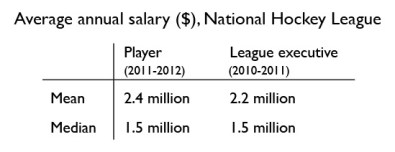
NHL executives make the same amount of money, on average, as the players whose salaries the league insists on cutting. Commissioner Gary Bettman was paid $7.98 million; he received a larger salary in 2011 than 98% of the players did in 2012.
Of course, while NHL player salaries are nearly identical to NHL executive salaries, they are undeniably far larger than average in the economy as a whole. However, players’ unusually large salaries are consistent with the unusually large amount of revenue generated by their labor.
Major league sports is a huge business that produces billions of dollars of revenue annually from the work of a small labor force. Averaged across the four major sports leagues in North America and based on figures reported by the Chicago Tribune in November 2012, the business of professional sports generates $5.9 billion a year in revenue for each league while employing 866 players3. That’s an average of $6.8 million in revenue per player.
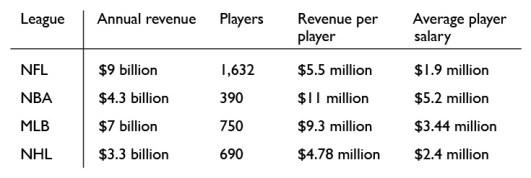
In comparison, the average S&P 500 company last year earned $420,000 in revenue per employee.
High player salaries are fully consistent with the revenue they produce; in this case, compensation correlates with productivity. The value of a commodity should also correlate with its scarcity — and a hockey player who makes it to the NHL is a precious rarity.
How scarce is NHL-caliber ability?
In 2012 the International Ice Hockey Federation (IIHF) reported over 1.6 million registered hockey players across its 72 member federations worldwide. Nineteen of these member nations had a player in the NHL last season. Limiting the field to males registered in these 19 countries leaves a total of 1.36 million hockey players who might dream of playing for the Stanley Cup. The 690 players who made it to an NHL team represent 0.05% of this talent pool.
What about the value of an NHL franchise owner?
Ownership of a professional sports franchise requires one qualification: the ability to make money or the good fortune to inherit or marry into it. NHL owners are perfectly qualified for this position — they’ve been exceptionally successful in making piles and piles of money. Among the 30 franchises, 10 NHL owners have managed to accumulate $1 billion or more in net worth, all of them from the U.S. or Canada. They comprise 2.2% of the pool of 450 billionaires in these countries.
A billionaire is 44 times more likely to buy an NHL franchise than a male hockey player is to make an NHL team. Put another way, an NHL-caliber player is 44 times more scarce than an NHL-owning billionaire — and scarcity, if any Econ 101 textbook can be trusted, drives economic value.
As employees, NHL players are compensated not only for high productivity and a rare skill set. Their occupation requires personal sacrifices: they give up time with their families, the stability of living in the same city from one year to the next, and most of all, their own health. Players risk serious injury every time they step on the ice. Injury can entail major surgery, painful rehab, and sometimes long-term physical, psychological, and cognitive damage. Cumulative or acute injuries that shorten or end careers can also cost millions in lost income.
The NHL obscures public information about injuries, but data tracked down and compiled by The Globe and Mail reports a total of 6,751 man-games lost to injury near the end of the 2010-2011 season, with an average of nine games still remaining for each team. On average, at every NHL game, three players on each team are unable to play due to injury.
Information on the number of sick days taken by Gary Bettman and other league executives and owners that year does not appear to be readily available. The number of work-related surgeries, lost teeth, and stitches among all NHL owners and executives is estimated to be zero.
Anyone with a fat bank account can buy a hockey team, but only a special few can play for it. How much do owners contribute to producing the $3 billion in annual league revenue? How much is due solely to the talent and sacrifice of the players?
But the NHL’s repeated labor disputes are not only about economics. At a deeper level, this conflict is about the meaning and ownership of hockey.
To NHL franchises, hockey is a commodity sold for profit. The league stages games to sell tickets — the single biggest source of revenue, comprising fully half of league income — and to drive demand for ancillary products such as broadcast rights, licensed merchandise, and concessions. For NHL owners, selling the game of hockey is like making widgets.
To players, hockey is a livelihood, a trade, but also a calling. They may be human widgets in the eyes of ownership, but professional hockey players are more akin to virtuoso artists. They practice an esoteric craft at the highest level, and by performing it for the pleasure of others are able to earn a living. Most hockey players, like most painters, musicians, and writers, can pursue their art only as a hobby. Most pay for the privilege. Only the rarest practitioners succeed in turning a passion into a career.
The league owns the franchises, but it does not own the game and it does not own the players.
To the owners, their employers, the players owe only the fulfillment of their contract obligations. Loftier contributions such as loyalty, respect, or even giving a damn about their work are purely optional; ownership and management don’t always grant these courtesies to players and they are not entitled to receive them. Players care because they owe it to themselves and they owe it to the magnificent game they are privileged to play.
Hockey belongs to its players. Not the owners who sign NHL paychecks, not the rinks that rent ice time, not even the fans who buy tickets. The players alone bring the game to life. From peewee to the pros, from the shaky adult beginner to the aspiring Olympian, every hockey player understands — and lives — the spirit of the game in a way no franchise owner, business executive, or league commissioner ever can.
Hockey lovers who return to the NHL after each corrosive labor dispute are drawn by the joy of witnessing the game performed at its highest level. The players are both the creators of this product and its sole owners — and no lockout or CBA can change that.
1 Calculations based on figures from the USA Today NHL salary database.
2 Calculations based on figures from the USA Today NHL salary database.
3 Based on number of teams multiplied by roster size: NFL, NBA, MLB, NHL.
 Covering the Puck
Reading the Play: Who Owns Hockey?
Posted: January 25, 2013 | Author: Covering the Puck | Filed under: Reading the Play (Commentary) |Comments Off on Reading the Play: Who Owns Hockey?January 25, 2013
For the NHL, this is a watershed moment: “The National Hockey League’s Board of Governors today ratified the terms of the Collective Bargaining Agreement negotiated with the NHL Players’ Association, … signaling a new era of cooperation and partnership.” After the ordeal of a rancorous labor dispute and lengthy lockout, the league is to embark on a new age of peace and prosperity.
But it’s July 22, 2005, when the NHL proclaims a new dawn, and the “new era” will not last. Seven years later, the league again locked out the players and commenced another rancorous labor dispute.
Like the fabled Aztec empire, the golden age of the National Hockey League was glorious but short-lived … although it did not end with the execution of its leader. Before its demise, the league’s new era flourished, achieving extravagant riches — more than $3 billion a year in revenue — and rapid growth — a 51% increase in franchise value.
What went wrong?
Somehow, the historic “cooperation and partnership” established between the league owners and the players in 2005 dissolved into accusations and acrimony. Who was at fault?
The dispute between league ownership and players is often dismissed as a battle of “the rich” (players) “versus the richer” (owners). The combatants are exceptionally wealthy, the fight over division of dollars is petty, and the whole mess boils down to greed.
But the relevant distinction between owners and players is not net worth; it is the position each occupies in the business of hockey. The conflict between ownership and players is better understood as employer versus employee; capital versus labor. The NHL is no different from Walmart in its agenda to minimize employee compensation and rights while exploiting employees’ talent and sweat for its own profit.
In many ways, as usual, capital has the upper hand in this fight. But the unique economics of professional sports changes the dynamics of this particular labor dispute. Ownership must confront the fundamental truth that owners are easily replaceable — with several aspiring owners waiting in the wings — but the players are not.
Predictably, NHL ownership does its best to deny this reality and portray the players as overpaid and selfish. But the common characterization of major-league professional athletes as “greedy” and “spoiled,” aided by the general public’s resentment of their large salaries, conflicts with the economic facts of the industry.
To begin with, player salaries are substantially smaller than commonly assumed. While the highest-paid superstars make headlines with their contracts, most players make far less. The number typically quoted as the average player salary in the NHL is the mean salary, $2.4 million in 2011-2012. But this figure is inflated by outliers at the top: the four players, out of about 700 players across the league, who earned $10 million or more.
A better measure of the typical player’s situation is the median salary, the midpoint between highest and lowest, which is only $1.5 million1. The mode, the salary earned by the largest group of players, is even lower: under a million at $900,0002.
One year earlier, in the 2010-2011 season, NHL executives whose salaries were reported by the league were paid an average (mean) salary of $2.2 million. The median executive salary that year was $1.5 million. (The sample was too small to have a useful mode.)
Although the two data sets are not quite comparable — the figures for player salaries are more recent and therefore inflated — they are sufficient to illustrate the relative scale of pay in the NHL.
NHL executives make the same amount of money, on average, as the players whose salaries the league insists on cutting. Commissioner Gary Bettman was paid $7.98 million; he received a larger salary in 2011 than 98% of the players did in 2012.
Of course, while NHL player salaries are nearly identical to NHL executive salaries, they are undeniably far larger than average in the economy as a whole. However, players’ unusually large salaries are consistent with the unusually large amount of revenue generated by their labor.
Major league sports is a huge business that produces billions of dollars of revenue annually from the work of a small labor force. Averaged across the four major sports leagues in North America and based on figures reported by the Chicago Tribune in November 2012, the business of professional sports generates $5.9 billion a year in revenue for each league while employing 866 players3. That’s an average of $6.8 million in revenue per player.
In comparison, the average S&P 500 company last year earned $420,000 in revenue per employee.
High player salaries are fully consistent with the revenue they produce; in this case, compensation correlates with productivity. The value of a commodity should also correlate with its scarcity — and a hockey player who makes it to the NHL is a precious rarity.
How scarce is NHL-caliber ability?
In 2012 the International Ice Hockey Federation (IIHF) reported over 1.6 million registered hockey players across its 72 member federations worldwide. Nineteen of these member nations had a player in the NHL last season. Limiting the field to males registered in these 19 countries leaves a total of 1.36 million hockey players who might dream of playing for the Stanley Cup. The 690 players who made it to an NHL team represent 0.05% of this talent pool.
What about the value of an NHL franchise owner?
Ownership of a professional sports franchise requires one qualification: the ability to make money or the good fortune to inherit or marry into it. NHL owners are perfectly qualified for this position — they’ve been exceptionally successful in making piles and piles of money. Among the 30 franchises, 10 NHL owners have managed to accumulate $1 billion or more in net worth, all of them from the U.S. or Canada. They comprise 2.2% of the pool of 450 billionaires in these countries.
A billionaire is 44 times more likely to buy an NHL franchise than a male hockey player is to make an NHL team. Put another way, an NHL-caliber player is 44 times more scarce than an NHL-owning billionaire — and scarcity, if any Econ 101 textbook can be trusted, drives economic value.
As employees, NHL players are compensated not only for high productivity and a rare skill set. Their occupation requires personal sacrifices: they give up time with their families, the stability of living in the same city from one year to the next, and most of all, their own health. Players risk serious injury every time they step on the ice. Injury can entail major surgery, painful rehab, and sometimes long-term physical, psychological, and cognitive damage. Cumulative or acute injuries that shorten or end careers can also cost millions in lost income.
The NHL obscures public information about injuries, but data tracked down and compiled by The Globe and Mail reports a total of 6,751 man-games lost to injury near the end of the 2010-2011 season, with an average of nine games still remaining for each team. On average, at every NHL game, three players on each team are unable to play due to injury.
Information on the number of sick days taken by Gary Bettman and other league executives and owners that year does not appear to be readily available. The number of work-related surgeries, lost teeth, and stitches among all NHL owners and executives is estimated to be zero.
Anyone with a fat bank account can buy a hockey team, but only a special few can play for it. How much do owners contribute to producing the $3 billion in annual league revenue? How much is due solely to the talent and sacrifice of the players?
But the NHL’s repeated labor disputes are not only about economics. At a deeper level, this conflict is about the meaning and ownership of hockey.
To NHL franchises, hockey is a commodity sold for profit. The league stages games to sell tickets — the single biggest source of revenue, comprising fully half of league income — and to drive demand for ancillary products such as broadcast rights, licensed merchandise, and concessions. For NHL owners, selling the game of hockey is like making widgets.
To players, hockey is a livelihood, a trade, but also a calling. They may be human widgets in the eyes of ownership, but professional hockey players are more akin to virtuoso artists. They practice an esoteric craft at the highest level, and by performing it for the pleasure of others are able to earn a living. Most hockey players, like most painters, musicians, and writers, can pursue their art only as a hobby. Most pay for the privilege. Only the rarest practitioners succeed in turning a passion into a career.
The league owns the franchises, but it does not own the game and it does not own the players.
To the owners, their employers, the players owe only the fulfillment of their contract obligations. Loftier contributions such as loyalty, respect, or even giving a damn about their work are purely optional; ownership and management don’t always grant these courtesies to players and they are not entitled to receive them. Players care because they owe it to themselves and they owe it to the magnificent game they are privileged to play.
Hockey belongs to its players. Not the owners who sign NHL paychecks, not the rinks that rent ice time, not even the fans who buy tickets. The players alone bring the game to life. From peewee to the pros, from the shaky adult beginner to the aspiring Olympian, every hockey player understands — and lives — the spirit of the game in a way no franchise owner, business executive, or league commissioner ever can.
Hockey lovers who return to the NHL after each corrosive labor dispute are drawn by the joy of witnessing the game performed at its highest level. The players are both the creators of this product and its sole owners — and no lockout or CBA can change that.
1 Calculations based on figures from the USA Today NHL salary database.
2 Calculations based on figures from the USA Today NHL salary database.
3 Based on number of teams multiplied by roster size: NFL, NBA, MLB, NHL.
Related