Reading the Play: Will Weber “Play On” in Music City?
Posted: July 20, 2012 Filed under: Reading the Play (Commentary) Comments Off on Reading the Play: Will Weber “Play On” in Music City?July 20, 2012
TSN reported yesterday that Shea Weber has signed a 14-year, $110 million offer sheet from the Philadelphia Flyers. The Nashville Predators, already jilted by Weber’s former defensive partner and newly minted Minnesota Wild Ryan Suter, have seven days to match the offer or accept draft picks in compensation for losing their captain.
Weber, who annually plays a forgotten Alydar to Zdeno Chara’s Affirmed in the NHL SuperSkills hardest shot competition, now gets his moment in the limelight: the contract vaults him to the top of the league’s best paid defensemen. According to CapGeek, Weber’s annual cap hit with this offer sheet places him above elite defenders Suter, Brian Campbell, Drew Doughty, and his hardest-shot nemesis Chara.
For the Predators, Suter’s signing with the Wild has triggered a nightmarish domino effect that could cost them their top defensive pair and biggest stars. Suter’s 13-year, $98 million contract with Minnesota not only “reset the market,” in the words of Weber’s agent, Jarrett Bousquet; it also reset the fate of Nashville’s roster. In an interview with TSN Radio 1050 Toronto, Bousquet alluded to Suter’s departure as a key factor in Weber’s desire to leave: “When things changed in Nashville, we felt that everything was set back a year or two and it looked to be more of a rebuilding situation.”
Asked whether Weber hopes the Predators decline to match the offer, Bousquet hesitated only briefly before stating plainly: “To answer your question, … he’d like to play with the Philadelphia Flyers. He doesn’t want to go through a rebuilding process again.”
If Bousquet is correct and the Predators captain wants to play elsewhere, signing a multiyear offer sheet is a risky move; if the Predators choose to match the offer, Weber would be effectively locked into the “rebuilding situation” in Nashville for the remainder of his career. Pressed about the potential for “hard feelings” if Nashville were to retain Weber’s services, Bousquet expressed little enthusiasm for the prospect but downplayed the possibility of lingering conflict: “I don’t foresee there being a problem in that regard.”
Predators president and general manager David Poile — who earlier in the month lamented, “We did not get a chance to make a counter-offer or anything like that” with Suter — reiterated his intention to “match and retain Shea” but noted it would take time to evaluate “the complexity of the offer sheet” — an implied reference to the front-loaded structure of the contract, which according to USA Today pays $28 million in the first 11 months.
Bousquet’s comments suggest Weber, if he does want to play in Philadelphia, is betting the Predators won’t be able or willing to come up with the money. While praising the team as “a great organization,” Bousquet added, “They’re under different constraints than other organizations are.”
Should the Predators fail to retain Weber only weeks after losing Suter to unrestricted free agency, the loss would usher in dark times for a franchise that has achieved consistent success despite playing in a small expansion market where hockey is overshadowed by country music. The Nashville Predators — according to the Nashville Predators — have earned a “reputation as one of the most stable, well-built teams in the NHL.” Sporting News concurs, saying the team is
an organization that has been a hallmark of small-market stability, with only one general manager and one head coach — Barry Trotz — since its inception in 1998. The Predators have been to the playoffs seven of the last eight seasons, advancing to the Western Conference semifinals each of the past two years.
While Poile in the front office has steered the franchise on a steady course, Trotz has managed the bench with the shrewdness of the James Bond villain he resembles.
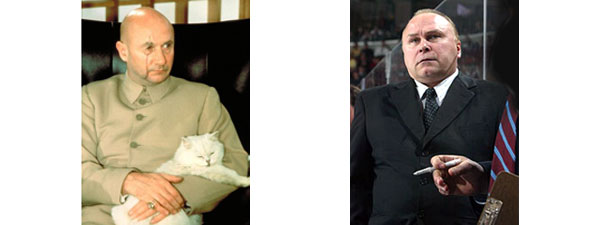
Two masterminds, with and without a cat
Defying expectations for a roster that boasts few marquee names with a payroll currently “more than $13 million below the salary floor,” the Predators have proven themselves a likable, feisty team succeeding not with flashy talent but through character and work. This postseason they eliminated perennial powerhouse Detroit, avenging two previous playoff series losses to the Red Wings.
But for a team that has always been short on elite talent, sustaining success will be a challenge without the two stars that have headlined their blue line. Aside from Weber, Suter, and the towering (6’5″), top-tier (league-leading 43 wins), underrated goalie Pekka Rinne, the most high-profile Predator is Mike Fisher, probably better known in Music City as country singer Carrie Underwood’s husband. Fisher, a forward, tallied only two more points (51) than defenseman Weber (49) during the 2011-2012 regular season; Suter contributed another 46 points. Weber led the team in plus-minus at +21; Suter was next at +15. No wonder Sporting News predicted that “[i]f Nashville lets Weber go after losing Suter, it will take years to recover.”
Now that Suter’s gone and captain Weber has one skate out the door, the future of the Nashville Predators rests solely on the thin shoulders of Pekka Rinne. His net could feel very lonely next season.
For Rinne, here are a few words of encouragement from Predators wife Underwood, taken from the title song of her third album:
Don’t you ever give up the fight
Even when you feel you’re all alonePlay on, play on
Reading the Play: Cracking the Ice Ceiling
Posted: July 14, 2012 Filed under: Reading the Play (Commentary) Comments Off on Reading the Play: Cracking the Ice CeilingJuly 14, 2012
The Chilliwack Progress reported yesterday on a “headache” facing the Chilliwack Minor Hockey Association (CMHA).
The Progress, of course, is Chilliwack’s 120-year-old “newspaper of record,” and Chilliwack, for the uninitiated, is a city of 80,000 located east of Vancouver which prominently features a large ear of corn on its official website.
Two parents whose children play in the CMHA have filed a formal complaint against the association with the B.C. Human Rights Tribunal, alleging gender discrimination. At issue is the CMHA’s recently instituted policy of levying a surcharge against players on girls’ teams. Members of boys’ or coed teams are not charged the extra fee.
The CMHA — whose league fees are structured on a per-player, not per-team, basis — has presented the policy as a simple business decision, citing the smaller rosters on girls’ teams which bring in less revenue per team. Its response to the lower rates of participation by girls is to increase the cost of participating.
The legal complaint will be decided via mediation or a hearing; resulting orders are enforceable in the B.C. Supreme Court. Whatever the outcome, the case has drawn attention to the place of women in hockey.
The state of women’s hockey last made news in 2010 when IOC president Jacques Rogge threatened to cut the sport from the Winter Olympics, setting a festive tone just hours before the gold medal game. Underdeveloped programs in every country except Canada and the U.S. result in lopsided games and a two-horse race in every international tournament.
Even within the two nations that dominate women’s hockey, participation by female players lags far behind their male counterparts. Despite what Hockey Canada describes as “exponential growth” in women’s hockey since the first World Women’s Championship in 1990, male players registered with the organization outnumbered females almost 6 to 1 in 2008-2009, the most recent year for which statistics are available. In the nation’s capital, male registration in the Ottawa District Hockey Association outnumbered female registration nearly 24 to 1.
With 2012 marking the 40th anniversary of Title IX, the landmark and controversial U.S. federal law best known for mandating gender equality in college sports participation, celebration of progress achieved must be tempered with awareness of work yet to be done.
This March The Gazette, native to hockey hotbed Montreal, examined the hockey lives of the Clarkson Cup-winning Montreal Stars, this year’s champions of the five-year-old, five-team Canadian Women’s Hockey League. The NHL recently raised its salary cap to $70.2 million for the upcoming season; meanwhile, players’ salaries in the CWHL jumped from negative $1000 to $0 minus the cost of food and sticks:
If you ask an NHL player about his love for the game, he might tell you that he loves it so much he would play for free.
The women love it so much they pay for the right to play.
“Things are getting better,” said Lisa-Marie Breton-Lebreux, the Stars’ captain and a driving force behind the creation of the league in 2007. “Last year, everyone on the team had to pay $1,000 to play. We have some sponsors and the crowds are a little better, so we don’t have to pay this season.”
But it’s still not free. While Bauer has supplied equipment to the players, they still pay for their sticks and they’re on the hook for their meals on the team’s seven road trips.
At least the Stars’ championship season was rewarded with a free meal and a suite at the Bell Centre when they were later honored at a Canadiens home game (though the food probably came at the price of witnessing Scott Gomez’s painfully futile efforts on the ice).
It’s been 20 years since groundbreaking goalie Manon Rheaume, the Geraldine Ferraro of hockey, signed a professional contract with the Tampa Bay Lightning in 1992.
Hockey’s Hillary Rodham Clinton has yet to emerge: no woman has repeated Rheaume’s feat. But the next one may be lacing up her skates at a rink near you.
Loose Pucks: Breaking Boundaries
Posted: July 13, 2012 Filed under: Loose Pucks (Miscellaneous) Comments Off on Loose Pucks: Breaking BoundariesJuly 13, 2012
NBC Washington yesterday profiled two aspiring NHLers with unconventional national backgrounds who are attending the Capitals’ Prospect Development Camp this week. The longer shot of the two is undrafted free agent Nathan Walker, who hopes to become “the first-ever Australian in the NHL” despite being passed over in the 2012 entry draft last month.
Europeans are well represented in North American pro hockey — 2012 Calder Trophy winner Gabriel Landeskog was the first European-born captain of a Canadian major junior team and newly retired Nicklas Lidstrom became the first European-born captain of a Stanley Cup champion team — but players from other continents remain out in the cold (or in this case, the dry heat). Mites and squirts hitting the ice at Australian hockey rinks — all 20 of them — can look to Walker to blaze the trail.
Not a hockey powerhouse, Australia does have some things in common with the game’s birthplace. No less an authority than the Toronto Star — “Canada’s largest daily newspaper”— declared in a 2010 column that
Australia and Canada have been linked in the world’s minds for a century. Both are geographically sprawling, resource-based, former British colonies that share language, history and guilt-laden problems with their native people and have become two of the richest nations in the world.
Regardless of whether Australia and Canada have ever been uppermost in the world’s minds — separately or together — the Star acknowledges that “the surface similarities mask fundamental differences” — none more fundamental than the state of hockey in each nation. There are six professional hockey leagues playing in Canada (NHL, AHL, ECHL, WHL, OHL, and QMJHL). There are nine teams playing in the “completely amateur” Australian Ice Hockey League, not only the country’s top league but “the biggest ice hockey league in the Southern Hemisphere.” Only in the Southern Hemisphere do leagues feel the need to insert the word “ice” before “hockey.”
But with all due respect to Walker — who according to NBC Washington has been called “the Wayne Gretzky of Australia” — he’s not the first Aussie to break into North American hockey.
The original Willie O’Ree of Australia?
None other than the Geico gecko, who during game broadcasts displays flashy stick skills and the impressive ability to maintain his balance on the ice with no skates and a tail.
True, some observers believe the gecko is actually a Brit with a Cockney accent, but consensus has not been reached on the matter of the lizard’s nationality. The Huffington Post columnist Stephen Schlesinger, who despises the gecko, identifies him as “[t]he little green lizard from Australia” who speaks with an “Australian twang.” The gecko himself is coy on the subject; The Inspiration Room blog quotes the lizard’s own (now defunct) blog as saying, “I’m not concerned with geography or nationality.”
Either way, Walker’s Aussie credentials are as suspect as the gecko’s. Though described as Australian, Walker was born in Wales before growing up in Sydney and signing with a hockey team in the Czech Republic. His nation of origin is identified by Elite Prospects as “Australia / U.K.”
For those who are interested, The Sidney Morning Herald noted in yesterday’s “Australian Ice Hockey League wrap” that Walker fans can view the prospect camp’s final scrimmage webcast on WashingtonCaps.com this coming Sunday (Saturday in D.C.’s time zone). Capitals Voice, the team’s official blog, reports that the scrimmage is part of Capitals FanFest.
Curiously, the Capitals make no mention of this intriguing connection, revealed under closer inspection of the team’s official website: “Washington Capitals FanFest Summer 2012 presented by Geico” (emphasis added).

Sydney synergy in action
As a final note, while Walker hopes to make the leap from Down Under to North America, there are players who go the other way. According to the Herald, each of the nine AIHL teams “is allowed four imports, usually professionals from European or lesser North American leagues.” Although the league is amateur, “imports are allowed to receive assistance to help with accommodation etc.” Suddenly the KHL doesn’t seem so bad.
Loose Pucks: Pucks Meet Paddles
Posted: July 12, 2012 Filed under: Loose Pucks (Miscellaneous) Comments Off on Loose Pucks: Pucks Meet PaddlesJuly 12, 2012
Although no goalies were among the 11 players who attended collective bargaining negotiations in Toronto on Tuesday, The Washington Times yesterday asked the Capitals’ former starter and current associate goaltending coach Olaf Kolzig to weigh in on the CBA talks and the likelihood of another labor dispute. Kolzig was still an active player when the 2004-2005 season was wiped out by a lockout after the last CBA expired. Reflecting on the NHLPA’s role in the failed negotiations that year, Kolzig said, “I don’t think our union was prepared for how tough a stance the owners had. I think we were waiting to call their bluff, and they didn’t blink. We didn’t really have a Plan B.”
The NHL of 2012 is much different from the cash-strapped, clutch-and-grab NHL of 2004, and the mood around the bargaining table seems lighter. Commissioner Gary Bettman characterized the proceedings as “constructive” and “cordial.” Still, the Players’ Association, led by its new post-lockout executive director Donald Fehr, is fully aware that the union came out the loser in the last CBA. As Fehr bluntly told The Globe and Mail in June, “The players made what can only be characterized as enormous concessions.” He took a slightly cooler tone than Bettman in describing the current negotiations, saying only, “The parties are approaching this in an appropriate and business-like manner.”
How will the players approach the bargaining table this summer — will they be tougher, more business-like, slower to blink? Do they have a Plan B?
Not only is there a Plan B, but the NHLPA sets a new tone on the homepage of its website, where the lead headline announces: “NHLPA Members to Compete in Charity Ping-Pong Tournament at Smashfest!”

Foremost on the minds of NHLPA members: Smashfest!
The union may be reticent on the matter of collective bargaining, but its members are overflowing with enthusiasm for Smashfest. Hosted by journeyman center Dominic Moore (currently a San Jose Shark), this “inaugural bash” promises to do nothing less than “crown hockey’s ping-pong champion.” For $200 a ticket, fans of hockey and of table tennis can come together to witness the drama as, “For The First Time Ever, A True Champion Will Be Crowned.” As if ping-pong isn’t enough to draw crowds, the event also offers “NHL stars, free-flowing beer, and plenty of food.”
Not to be mistaken for a frivolous lark, Smashfest will raise money for concussion research. Career-ending-concussion poster boy Eric Lindros — who last month was passed over for the third time by the selection committee of the Hockey Hall of Fame — leads the roster of players trading their sticks for paddles.
Ping-pong junkies who just can’t wait for the excitement to begin can monitor the website’s countdown clock until the first player opens serve today at 7 p.m. The site also provides interesting facts about little-known NHL players participating in the table tennis tournament. For example, the event says of its host, “Dominic’s tenacity and work ethic make him a hot commodity” — presumably on the ping-pong circuit.

 Covering the Puck
Reading the Play: When Captains Abandon Ship
Posted: July 26, 2012 | Author: Covering the Puck | Filed under: Reading the Play (Commentary) | Comments Off on Reading the Play: When Captains Abandon ShipJuly 26, 2012
Some major names made headlines in the NHL this week. The big news out of Columbus on Monday?
Blue Jackets pull off a blockbuster
Blue Jackets GM Scott Howson bubbled over with enthusiasm as he announced the deal: “We are excited to complete this trade today as we believe the acquisitions … have advanced the club and put us in a stronger position to achieve our goal of winning the Stanley Cup.”
To help introduce Columbus fans to the new players who will be leading the charge for the Cup, the Blue Jackets summarized their career highlights to date:
Talent of that caliber doesn’t come for free, of course, so in exchange the Blue Jackets sent Steven Delisle, a conditional third-round pick, and their captain Rick Nash to New York. The considerate Blue Jackets helpfully summarized the career highlights of Nash as well. He “is the Blue Jackets’ all-time leader in”:
Also, this past season “he led the club … in goals (30) for the eighth straight season and points (59) for the fifth straight season … , while setting a career high in games played (82).”
Anyone can see why Howson was so excited to complete this trade. The Columbus coup, however, was upstaged the next day by the second major news story of the week. The big headline was featured prominently on the Philadelphia Flyers’ website Tuesday:
News for the nearsighted
Here’s a closer look:
A Weber is worth 63 words
Philadelphia’s four-sentence story was dwarfed by coverage around the rest of the league. Flyers GM Paul Holmgren’s terse statement contrasted with the Predators’ press release announcing “the most important hockey transaction in franchise history.”
Nashville, a feisty team on the ice, showed some spirit from the front office, defiantly proclaiming that the Predators won’t “be pushed around by teams with ‘deep pockets.'” Hear that, Minnesota?
Despite Nashville’s well deserved pride in their triumph over the would-be poachers from Pennsylvania, troubling questions remain about the loyalty and commitment of their captain after his dalliance with another team. On Tuesday The Tennessean quoted Weber’s agent, Jarrett Bousquet, saying, “He’s glad to be back…. He’s really happy that ownership made the commitment to him.”
Five days earlier, Bousquet had told TSN Radio 1050 Toronto that Weber would “like to play with the Philadelphia Flyers. He doesn’t want to go through a rebuilding process again.”
Weber himself, slinking back into town with his Predator tail between his legs, disavowed Bousquet’s claims that he wanted to leave Nashville. According to The Tennessean, Weber said in a teleconference yesterday, “I was never a part of any of that. I didn’t make any statements publicly.”
Like a straying husband trying to win back a betrayed wife, Weber professed deep feelings for the city of Nashville, the people of Nashville, and the on-ice employees of Nashville: “I love the city of Nashville. I love the fans and my teammates.” He even expressed great affection for the Predators’ facility, saying “everyone that has played [in Nashville] knows how great the city is and … they love the atmosphere at the rink.”
But surely fans and teammates anxious for reassurance can’t help but notice that Weber failed to mention the franchise and team itself and said nothing about how great it is to play for Nashville. No doubt Nashville boasts better barbecue and warmer weather than Philly, but does Weber really want to play there?
The Predators may put on a good face, but they must confront the strong likelihood that their longtime captain and franchise player would rather not be with them. General manager David Poile, quoted on the league website, likened the 14-year contract to “a marriage”; given that Weber was dragged to the altar after attempting to elope with the Flyers, some marital counseling may be in order.
An awkward family reunion
History does offer hope for reconciliation between Weber and the Predators. Avalanche captain Joe Sakic had a well publicized fling with the Rangers in 1997, signing a front-loaded $21 million offer sheet designed to break the bank for a financially struggling Colorado franchise, but the flirtation was never consummated and, over time, Avs fans renewed their love affair with Sakic. Unlike Weber, though, Sakic made sure his affection for Denver was never in doubt, reported in the (New York) Daily News as saying, “Everyone knows how much I like it here.”
Nashville is not alone in experiencing a captain’s betrayal. The Predators at least have a chance to mend their relationship with their captain; two other teams this summer have lost their star captains entirely. Zach Parise, fresh off a Stanley Cup Finals appearance, fled New Jersey for his home-state team and $98 million. And Nash, who requested a trade away from the Blue Jackets months ago during the season, was clearly thrilled to escape Columbus. The giddy Rangers said on their website that joining New York was a dream come true for Nash and offered a “Rick Nash Quote Book” featuring such memorable lines as: “I wanted to play somewhere that I wanted to be and my number one priority was to be here, and I’m just happy it worked out. This is a world class team, and I’m excited to be here.”
Someone pinch Rick Nash
Every NHL locker room has a revolving door; players constantly come and go. But losing a captain is more than an ordinary roster change and is particularly disheartening when the captain runs for the exit. One other team lost its captain this summer to retirement, but the end of Nick Lidstrom’s tenure is also an occasion to celebrate his long, productive, and exclusive relationship with the Red Wings. The departures of Parise and Nash and the near loss of Weber were rejections of their respective teams, and for New Jersey and Columbus, outright abandonment.
A captain isn’t supposed to abandon ship — even when it’s sinking and certainly not when it just sailed to the Cup Finals. Didn’t Rick Nash or Zach Parise ever watch Star Trek? Captain Picard, the epitome of leadership on the final frontier, always resorted to self-destructing the ship before he’d surrender the Enterprise.
Who best to steer the ship?
In space, at sea, or on the ice, being abandoned by a captain is tough to take. The crew members left behind can’t waste time trying to make sense of their leader’s desertion; they’ve got to scramble for the life boats or try to swim to shore. Even if they make it, they’ll probably spend some time feeling marooned.